Yesterday it was reported that Trevor Graham would be charged with perjury today. He has been. You can read the geezers blab about it; the drunk tank is remarkably quiet about it.
Really, there's no surprise. No one is shocked, shocked to find out there's drug use going on over there. Strange as it is, this is a bigger story on NPR than in track circles.
Thursday, November 02, 2006


Sunday, October 29, 2006
Don't Get Fooled Again
Track & Field News' front page links to a Washington Times editorial about Title IX and James Madison University.
I wrote about the whole hoo-ha a while back. Now, anyone who can read knows the cuts were not about balancing a male-female ratio, since three women's sports were cut. Well, maybe you have to be able to divide, too, but the AD was clearly dissembling. Those cuts certainly do not call for a change in the law. A change in university leadership, sure, but not a change in law.
It's also useful to know the source of the editorial. The Washington Times, which sounds as venerable and reliable as the Washington Post or the New York Times, was started in 1982 by Rev. Sun Myung Moon. Yep, the leader of the Unification Church, aka "the Moonies". It makes up one-third of the "conservative news media" with Fox News and right-wing talk radio. Even onetime conservative columnist David Brock thinks it's a hack paper, writing that it "was governed by a calculatedly unfair political bias and that its journalistic ethics were close to nil."
So read if you like, but take it with a grain of salt. Any convincing opposing viewpoint has been carefully excised.
I wrote about the whole hoo-ha a while back. Now, anyone who can read knows the cuts were not about balancing a male-female ratio, since three women's sports were cut. Well, maybe you have to be able to divide, too, but the AD was clearly dissembling. Those cuts certainly do not call for a change in the law. A change in university leadership, sure, but not a change in law.
It's also useful to know the source of the editorial. The Washington Times, which sounds as venerable and reliable as the Washington Post or the New York Times, was started in 1982 by Rev. Sun Myung Moon. Yep, the leader of the Unification Church, aka "the Moonies". It makes up one-third of the "conservative news media" with Fox News and right-wing talk radio. Even onetime conservative columnist David Brock thinks it's a hack paper, writing that it "was governed by a calculatedly unfair political bias and that its journalistic ethics were close to nil."
So read if you like, but take it with a grain of salt. Any convincing opposing viewpoint has been carefully excised.
OAC Championships, High School Regionals
Yesterday was the OAC Championships hosted by Heidelberg College. I tried to write a post this morning but Blogger had some problems.
The Site
Tiffin annually hosts one of the nation's largest high school cross country meets, the Tiffin Carnival, at Hedges Boyer Park. I was surprised to find that Heidelberg's home course is not at Hedges Boyer, and in fact the OHSAA regional competition would be going on there at the exact same time!
The course was at Clinton Heights Golf Club. This being D-III, I expected a country club. Instead, I drove up and saw this:
 It's rural northwest Ohio, and therefore without pretension. I like it. It obviously had once been a farm; it's mostly flat and open with one creekbed offering a small amount of roll. The course itself is a double loop mostly around the perimeter of the golf course.
The Conditions
They were about as unpleasant as you can get around here. Days of rain had totally saturated the ground. Temperatures were just above 30 with steady 20-25 mph wind. It rained on and off, and at one point we had hail. I would have much preferred everything frozen instead of wet.
The Men's Race
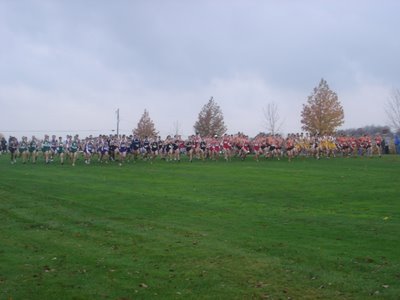 A thread on Let's Run discussed the favorites, but we got a preview three weeks ago at the All-Ohio championships. The polls would have you believe Mount Union was going to win in a walkover, and they did beat Ohio Northern at the All-Ohio meet by 18 points. Heidelberg was next, with the rest of the OAC well in arrears. There would have been little reason to expect otherwise.
Scott Lasch of Heidelberg took an early lead. Here he is at 1 1/2 miles:
 Following him, it looked like Mount Union had things well in hand:
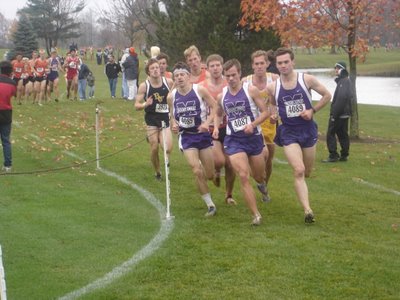 The next time I saw them come by, just past 4 miles, things were radically different. Lasch was fallnig back as heavy favorite Jeremy Velliquette of Mt. Union moved up to the front.
 More interestingly, Mt. Union's pack had fallen apart, with their fifth man well back, and Ohio Northern's runners were moving up. It looked like their first four runners were doing well enough to hold on to the title, but there was still almost a mile of running left. The title was up for grabs.
At the finish, Velliquette won relatively confortably with ONU's Paul Lewis running very well for second. Heidelberg went 3-4, Mt. Union took 5-6, and then came the Polar Bears with 8-9-11-12, broken up only by Mt. Union in 10th. Two more ONU runners crossed the line before Union's fifth man did.
ONU track coach Brian Cole started adding up the numbers, and had 41 for Mt. Union to 42 for Ohio Northern. XC coach Jason Maus told him to add it again. But it was right, and the Crusaders held on for the narrowest of wins. ONU put seven runners in front of everyone else's fifth, and Cole admitted there was nothing more his men could have done.
The Women's Race
As eventful and unpredictable as the men's race was, the women's was just the opposite. ONU was a heavy favorite and their title was never in any real doubt. Somewhat surprising was how the individual title played out, as Otterbein's Melinda Keesee took an early lead and was never pressed. Three weeks ago at All-Ohio, ONU's Darci Walthew was easily the top D-III runner, handily beating Keesee.
 The difference? I don't thik it's a briliant job of peaking by Otterbein's coach and a poor one by ONU's, but rather succombing to the elements. Walthew is what Lydiard called a "driver", a muscular and powerful runner who pushes off the gound very hard rather than seeming to float over it. Such runners do well on the track or road, but are severely hampered on soft surfaces. Yesterday's race was through deep mud, and Walthew's strength could not be put to use.
The High School Meet
I hightailed it across town to see what remained of the high school regionals. The upset of the day was in the Division I girl's race. Bowling Green High School is the two-time defending state champions, ranked #1 in the state, and were not expected to be challenged at all yesterday. They finished third and were a mere 14 points away from being eliminated from state competition. #4 runner Shannon Titus was resting a sore leg (and strangely, she was not replaced as the Bobcats only ran six girls), but even with her in the mix they would barely have won the title over an unranked team. Things do not look good for a third consecutive state title.
The story of the day, however, was in a race I missed. Local runner Corey Johnson of Eastwood High School was a shoo-in to qualify to the state meet. That was before Monday, when he suffered a "severe injury" to his left thumb in an Industrial Arts class. (No real details were given, but reading between the lines it appears very bad.) On Wednesday he underwent surgery on the thumb and on Friday tried to run but the pain almost knocked him off his feet. He ran in yesterday's deplorable conditions and was nearly taken away in an ambulance.
 He finished the race. Three places shy of a state berth. We wish him well on his recovery, and we know he will be a great collegiate runner.
The Site
Tiffin annually hosts one of the nation's largest high school cross country meets, the Tiffin Carnival, at Hedges Boyer Park. I was surprised to find that Heidelberg's home course is not at Hedges Boyer, and in fact the OHSAA regional competition would be going on there at the exact same time!
The course was at Clinton Heights Golf Club. This being D-III, I expected a country club. Instead, I drove up and saw this:
 It's rural northwest Ohio, and therefore without pretension. I like it. It obviously had once been a farm; it's mostly flat and open with one creekbed offering a small amount of roll. The course itself is a double loop mostly around the perimeter of the golf course.
The Conditions
They were about as unpleasant as you can get around here. Days of rain had totally saturated the ground. Temperatures were just above 30 with steady 20-25 mph wind. It rained on and off, and at one point we had hail. I would have much preferred everything frozen instead of wet.
The Men's Race
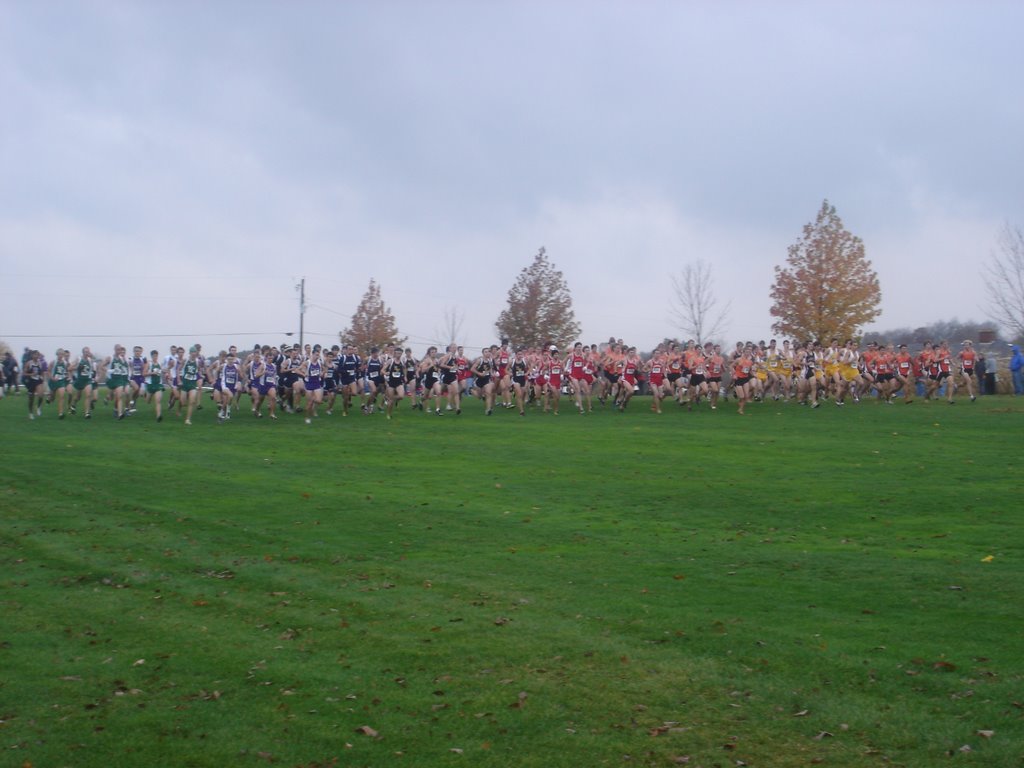 A thread on Let's Run discussed the favorites, but we got a preview three weeks ago at the All-Ohio championships. The polls would have you believe Mount Union was going to win in a walkover, and they did beat Ohio Northern at the All-Ohio meet by 18 points. Heidelberg was next, with the rest of the OAC well in arrears. There would have been little reason to expect otherwise.
Scott Lasch of Heidelberg took an early lead. Here he is at 1 1/2 miles:
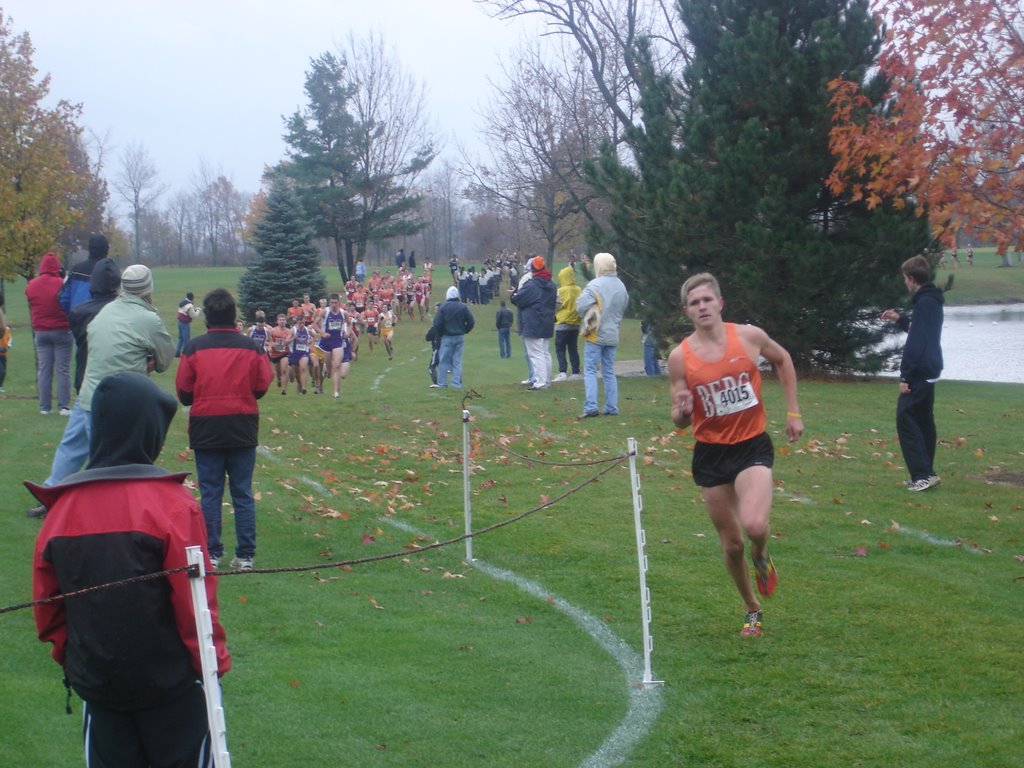 Following him, it looked like Mount Union had things well in hand:
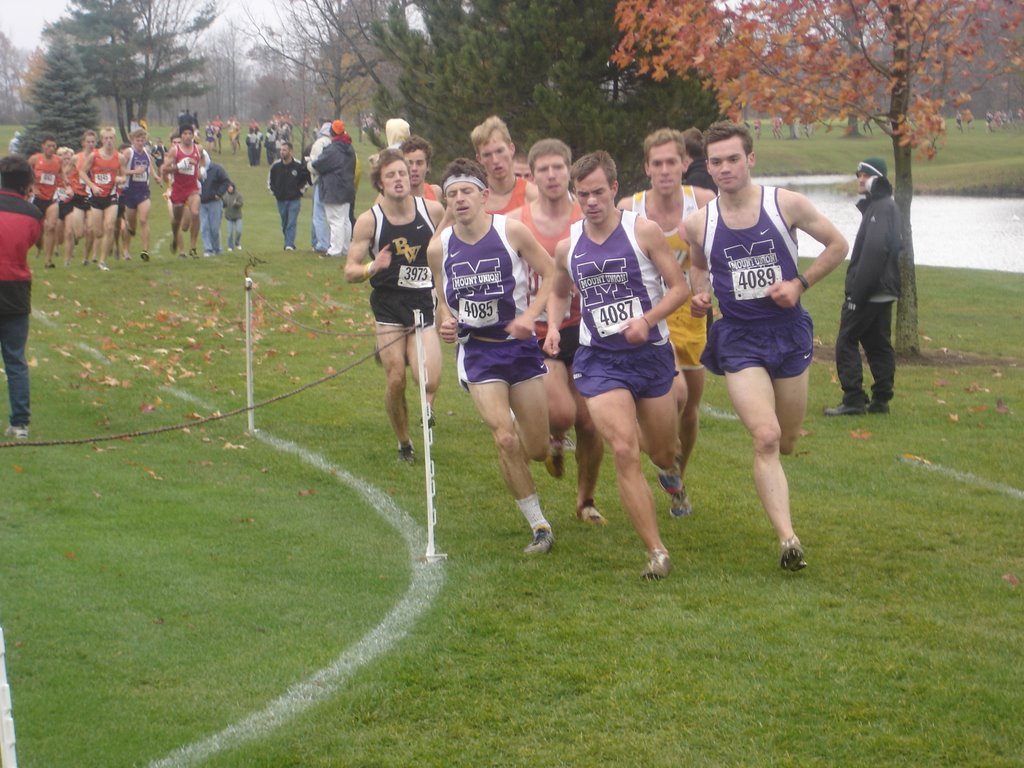 The next time I saw them come by, just past 4 miles, things were radically different. Lasch was fallnig back as heavy favorite Jeremy Velliquette of Mt. Union moved up to the front.
 More interestingly, Mt. Union's pack had fallen apart, with their fifth man well back, and Ohio Northern's runners were moving up. It looked like their first four runners were doing well enough to hold on to the title, but there was still almost a mile of running left. The title was up for grabs.
At the finish, Velliquette won relatively confortably with ONU's Paul Lewis running very well for second.
 Heidelberg went 3-4, Mt. Union took 5-6, and then came the Polar Bears with 8-9-11-12, broken up only by Mt. Union in 10th. Two more ONU runners crossed the line before Union's fifth man did.
ONU track coach Brian Cole started adding up the numbers, and had 41 for Mt. Union to 42 for Ohio Northern. XC coach Jason Maus told him to add it again. But it was right, and the Crusaders held on for the narrowest of wins. ONU put seven runners in front of everyone else's fifth, and Cole admitted there was nothing more his men could have done.
The Women's Race
As eventful and unpredictable as the men's race was, the women's was just the opposite. ONU was a heavy favorite and their title was never in any real doubt. Somewhat surprising was how the individual title played out, as Otterbein's Melinda Keesee took an early lead and was never pressed. Three weeks ago at All-Ohio, ONU's Darci Walthew was easily the top D-III runner, handily beating Keesee.
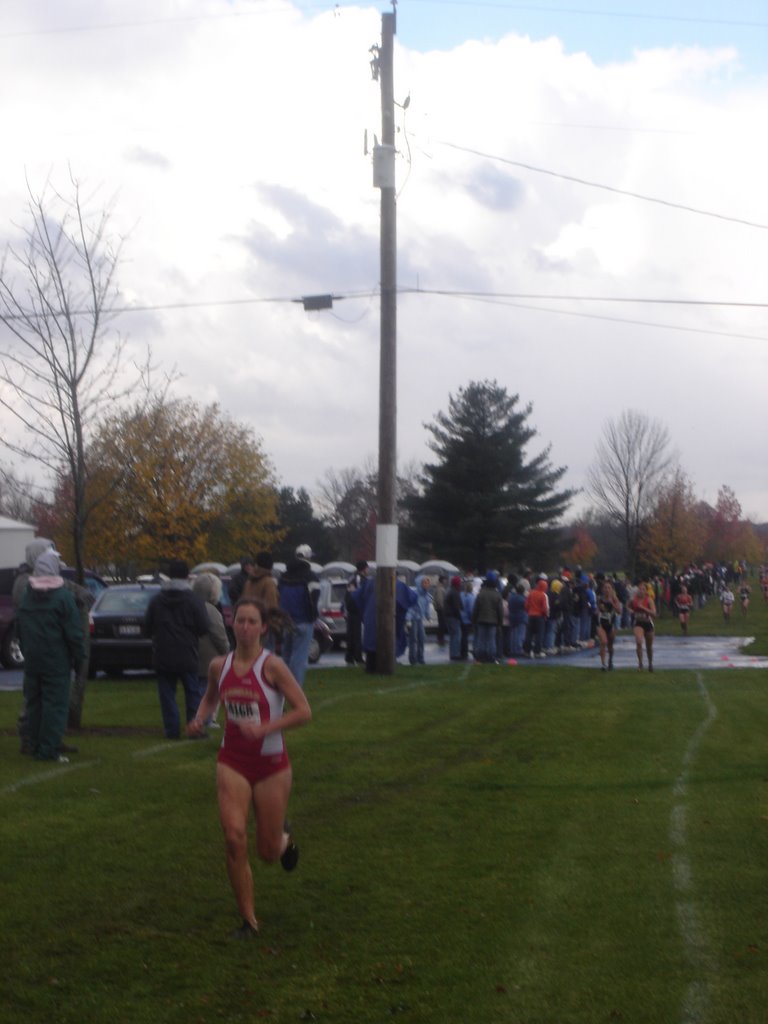 The difference? I don't thik it's a briliant job of peaking by Otterbein's coach and a poor one by ONU's, but rather succombing to the elements. Walthew is what Lydiard called a "driver", a muscular and powerful runner who pushes off the gound very hard rather than seeming to float over it. Such runners do well on the track or road, but are severely hampered on soft surfaces. Yesterday's race was through deep mud, and Walthew's strength could not be put to use.
The High School Meet
I hightailed it across town to see what remained of the high school regionals. The upset of the day was in the Division I girl's race. Bowling Green High School is the two-time defending state champions, ranked #1 in the state, and were not expected to be challenged at all yesterday. They finished third and were a mere 14 points away from being eliminated from state competition. #4 runner Shannon Titus was resting a sore leg (and strangely, she was not replaced as the Bobcats only ran six girls), but even with her in the mix they would barely have won the title over an unranked team. Things do not look good for a third consecutive state title.
The story of the day, however, was in a race I missed. Local runner Corey Johnson of Eastwood High School was a shoo-in to qualify to the state meet. That was before Monday, when he suffered a "severe injury" to his left thumb in an Industrial Arts class. (No real details were given, but reading between the lines it appears very bad.) On Wednesday he underwent surgery on the thumb and on Friday tried to run but the pain almost knocked him off his feet. He ran in yesterday's deplorable conditions and was nearly taken away in an ambulance.
He finished the race. Three places shy of a state berth. We wish him well on his recovery, and we know he will be a great collegiate runner.
Friday, October 27, 2006
Anti-Doping News
Bernard Lagat has given up suing the IAAF over lost income during his provisional ban for EPO. The short form of the decision is "you can't say exactly how much you lost, so you get nothing". I might add that in terms of prize money nothing is guaranteed, so he could not prove he would have won a dime. I will not shed a tear for him, as I've always thought he was guilty and just got lucky on the B sample. I mean, a Kenyan going to a U.S. university and getting better? It makes about as much sense as a Buddhist monk going to the Middle East to learn about tolerance and peace.
Trevor Graham's top assistant Randall Evans was interviewed by the BALCO grand jury. Graham's lawyer said Evans "told the grand jury that he knows nothing about Trevor being involved in the distribution of illicit substances." I'm sure he also would have testified that Michael Corleone was only in the business of importing olive oil.
Trevor Graham's top assistant Randall Evans was interviewed by the BALCO grand jury. Graham's lawyer said Evans "told the grand jury that he knows nothing about Trevor being involved in the distribution of illicit substances." I'm sure he also would have testified that Michael Corleone was only in the business of importing olive oil.
Sunday, October 22, 2006
Next Saturday I will resume full-time Superfan status, as my team's cross country season is over. I'll attempt to see six races in one day, but I might only get in four or five.
First up is the OAC Cross Country Championships, hosted by Heidelberg University at Clinton Heights golf course in Tiffin, Ohio. The men (8k) run at 11 AM, the women (6k) at noon. For those of you outside the Ohio area, the Ohio Athletic Conference is the nation's third oldest, and Ohio State had such respect for the organization that it continued to remain dues-paying member for decades after no longer competing in the conference. It is the prototype small-college student-first athletic organization. The favorites are Mount Union for the men, Ohio Northern for the women.
From there, I'll hightail it over to Tiffin's Hedges-Boyer Park for the OHSAA Regional Cross Country meet, which (argh!) also starts at 11 AM. With boys' and girls' races on tap in each of three divisions, I should be able to see the final three or four races of the day.
First up is the OAC Cross Country Championships, hosted by Heidelberg University at Clinton Heights golf course in Tiffin, Ohio. The men (8k) run at 11 AM, the women (6k) at noon. For those of you outside the Ohio area, the Ohio Athletic Conference is the nation's third oldest, and Ohio State had such respect for the organization that it continued to remain dues-paying member for decades after no longer competing in the conference. It is the prototype small-college student-first athletic organization. The favorites are Mount Union for the men, Ohio Northern for the women.
From there, I'll hightail it over to Tiffin's Hedges-Boyer Park for the OHSAA Regional Cross Country meet, which (argh!) also starts at 11 AM. With boys' and girls' races on tap in each of three divisions, I should be able to see the final three or four races of the day.
Obligatory Chicago Marathon Post
Winners were Robert Cheruyiot (2:07:35) and Berhane Adere (2:20:42), sending both to the top of the World Marathon Majors standings. It appears it may actually make Sportscenter, if only for the nasty slip-n-fall by Cheruyiot as he crossed the finish line.
Cheruyiot was the best of a large group that played the waiting game. Adere played it smart while Romania’s Constantina Tomescu-Dita took it out hard and died--a tactic that's blown up in her face multiple times in the past. Apparently, Cheruyiot could have used her thick skull if only at the finish line.
Cheruyiot cannot be equaled in the points standing until next spring, as he's gone two-for-two while the only other race winners, Felix Limo and Haile Gebrselassie, are done for the fall. He's put himself in a very good position.
For the women, Adere is first mostly because only one other woman has scored in two races as of yet. The real fireworks will come on the streets of New York on November 5, as Rita Jeptoo (Boston champ), Deena Kastor (London champ) Jelena Prokopcuka (Boston runner-up), and Susan Chepkemei (London 3rd place) face off.
Cheruyiot was the best of a large group that played the waiting game. Adere played it smart while Romania’s Constantina Tomescu-Dita took it out hard and died--a tactic that's blown up in her face multiple times in the past. Apparently, Cheruyiot could have used her thick skull if only at the finish line.
Cheruyiot cannot be equaled in the points standing until next spring, as he's gone two-for-two while the only other race winners, Felix Limo and Haile Gebrselassie, are done for the fall. He's put himself in a very good position.
For the women, Adere is first mostly because only one other woman has scored in two races as of yet. The real fireworks will come on the streets of New York on November 5, as Rita Jeptoo (Boston champ), Deena Kastor (London champ) Jelena Prokopcuka (Boston runner-up), and Susan Chepkemei (London 3rd place) face off.
What the ...?
The other day I saw a wierd thread title at LetsRun.com: "Why does J Squires hate Ryun so much?"
Before answering that question, I've got to explain where this all came from. In various forums I've argued that Ryun's career accomplishments are a bit overstated, and his contemporary Kip Keino's accomplishments are understated. But I haven't made this argument in years.
Apparently, in another thread about Jim Ryun someone else has been making the same argument, and it's been assumed that it's me. I don't post under pseudonyms, however; I think it's a chickenshit lowlife thing to do. Also, anyone who knows my writing style would immediately recognize it as not mine.
If you read the first thread I linked to, there are some fairly nasty comments involved (although they aren't that mean by Let's Run standards). Should I be angry that I'm getting grief for something I didn't even do? Well, in the words of Dick Armitage, "The higher you climb up the tree, the more your ass shows", meaning that if people read my stuff and know who I am then somebody's going to take potshots at me. I have to take the bad with the good if I'm going to put my opinions online.
Here's my argument on Jim Ryun: while his two years at the top (1966-67) were probably the two greatest seasons a miler has ever had, two years simply isn't enough to say that he's the best miler ever. His contemporary, Kip Keino, never set a World Record or cracked the top three in Athlete of the Year voting, but showed remarkable consistency over an eight-year period. Comparing them is in effect trying to compare apples and oranges. Who you pick depends entirely on what you think is important.
When trying to compare the all-time greats in each event, my criteria reward consistency over short bursts of brilliance, and winning over world records. I didn't just make these criteria up; they are based on those of Track & Field News' World Rankings and Bill James' Historical Baseball Abstract. For the most part, I look at what the athlete was able to accomplish in his/her best four-year streak, and any additional accomplishments in other seasons pad this record. On the whole, Keino comes out better than Ryun but just barely. Neither one comes close to Paavo Nurmi, Gunder Hagg, Nourredine Morceli, or Hicham El Guerrouj.
While many great milers say Ryun was the best ever, I think they're referring to him at his peak (when none of them would have wanted to race him) while ignoring the basket case he became shortly after that. It should be noted that Joe Vigil, who knows a thing or two about running, has said that Keino's performance in the 1968 Olympic 1500m was the greatest of all time (I think he was purposefully exaggerating in order to make a point).
What really irks me, though, is the attitudes surrounding this comparison. First of all, I never have seen or read of Ryun ever giving credit to Keino for beating him in 1968; he always has some excuse or mitigating factor to blame. Injuries, illness, altitude, the Kenyan teamwork, whatever. He just couldn't bring himself to say that Keino had a great race and deserved to win.
In 1968 Ryun got mononucleosis and then had hamstring problems. Both of these afflictions are severe and debilitating, and a lesser man might not have been able to battle through them. But he did, posting the fourth-best time of his life at the high altitude of Mexico City. And Kip Keino kicked his ass. The altitude undoubtedly gave Keino an advantage, but Keino posted a time that only Ryun had ever beaten; even a highlander suffers some effect at altitude (while not as much as lowlanders do) and a reasonable conclusion is that Keino's performance was more or less equivalent to Ryun's WR. Ryun's performance was probably nearly as good.
But from 1968 on, Ryun was never the same. His apologists blame the '68 mono and hamstring problems--which are a big deal. But it seems unreasonable to think those afflictions affected him more as the years went by than they did in the year he got them. I'm certain his problems were mental and not physical. In October of 1968 his unshatterable belief in himself got shattered.
What grates me even more is that most of these same people say all of the East Africans who won medals in '68 got them solely because of the altitude. This is pure ignorance. Of them, only one (amos Biwott) was a "flash in the pan" who never did anything before or since. The rest had to have been considered serious threats to win or medal no matter where the Games were held. Keino was the world's #2 miler and in the top two at 5k in each of the years 1965-67; Wilson Kiprugut and Mohamed Gammoudi had medaled in 1964; Mamo Wolde was a top track runner throughout the 60s; Naftali Temu had been the world's #1 man at 10k in '66 and '67 (with a win over Ron Clarke at the '66 Commonwealth Games in Jamaica). These men were not ready for a breakthrough in '68 because they'd already made one. The worldwide press just didn't know it.
Racism may or may not be a factor in these attitudes about the Kenyans and Ethiopians. Having spent most of my life as a minority in a black world, I generally see it when other white people don't. American exceptionalism is an ugly attitude that often gets paired up with it. I see both at work here. If you need any proof, look at the white upper-middle class American attitudes towards Billy Mills (who beat Clarke in cahmpionship competition once) and Temu (who never lost to Clarke in championship competition). If you reject this comparison out of hand, maybe you should take a good look at yourself.
I admit that I like what Keino has done with his life after track much more than what Ryun has done, but that doesn't affect how I evaluate their accomplishments. Keino has taken in and raised hundreds of children left orphans (mostly due to AIDS). Ryun, as a Congressional representative, voted to reverse Art. I, Section 9 and Art. 6 of the US Constitution. If things like that clouded my judgement I'd begin arguing that Mike Boit was a better half-miler than Seb Coe, which he clearly was not.
Before answering that question, I've got to explain where this all came from. In various forums I've argued that Ryun's career accomplishments are a bit overstated, and his contemporary Kip Keino's accomplishments are understated. But I haven't made this argument in years.
Apparently, in another thread about Jim Ryun someone else has been making the same argument, and it's been assumed that it's me. I don't post under pseudonyms, however; I think it's a chickenshit lowlife thing to do. Also, anyone who knows my writing style would immediately recognize it as not mine.
If you read the first thread I linked to, there are some fairly nasty comments involved (although they aren't that mean by Let's Run standards). Should I be angry that I'm getting grief for something I didn't even do? Well, in the words of Dick Armitage, "The higher you climb up the tree, the more your ass shows", meaning that if people read my stuff and know who I am then somebody's going to take potshots at me. I have to take the bad with the good if I'm going to put my opinions online.
Here's my argument on Jim Ryun: while his two years at the top (1966-67) were probably the two greatest seasons a miler has ever had, two years simply isn't enough to say that he's the best miler ever. His contemporary, Kip Keino, never set a World Record or cracked the top three in Athlete of the Year voting, but showed remarkable consistency over an eight-year period. Comparing them is in effect trying to compare apples and oranges. Who you pick depends entirely on what you think is important.
When trying to compare the all-time greats in each event, my criteria reward consistency over short bursts of brilliance, and winning over world records. I didn't just make these criteria up; they are based on those of Track & Field News' World Rankings and Bill James' Historical Baseball Abstract. For the most part, I look at what the athlete was able to accomplish in his/her best four-year streak, and any additional accomplishments in other seasons pad this record. On the whole, Keino comes out better than Ryun but just barely. Neither one comes close to Paavo Nurmi, Gunder Hagg, Nourredine Morceli, or Hicham El Guerrouj.
While many great milers say Ryun was the best ever, I think they're referring to him at his peak (when none of them would have wanted to race him) while ignoring the basket case he became shortly after that. It should be noted that Joe Vigil, who knows a thing or two about running, has said that Keino's performance in the 1968 Olympic 1500m was the greatest of all time (I think he was purposefully exaggerating in order to make a point).
What really irks me, though, is the attitudes surrounding this comparison. First of all, I never have seen or read of Ryun ever giving credit to Keino for beating him in 1968; he always has some excuse or mitigating factor to blame. Injuries, illness, altitude, the Kenyan teamwork, whatever. He just couldn't bring himself to say that Keino had a great race and deserved to win.
In 1968 Ryun got mononucleosis and then had hamstring problems. Both of these afflictions are severe and debilitating, and a lesser man might not have been able to battle through them. But he did, posting the fourth-best time of his life at the high altitude of Mexico City. And Kip Keino kicked his ass. The altitude undoubtedly gave Keino an advantage, but Keino posted a time that only Ryun had ever beaten; even a highlander suffers some effect at altitude (while not as much as lowlanders do) and a reasonable conclusion is that Keino's performance was more or less equivalent to Ryun's WR. Ryun's performance was probably nearly as good.
But from 1968 on, Ryun was never the same. His apologists blame the '68 mono and hamstring problems--which are a big deal. But it seems unreasonable to think those afflictions affected him more as the years went by than they did in the year he got them. I'm certain his problems were mental and not physical. In October of 1968 his unshatterable belief in himself got shattered.
What grates me even more is that most of these same people say all of the East Africans who won medals in '68 got them solely because of the altitude. This is pure ignorance. Of them, only one (amos Biwott) was a "flash in the pan" who never did anything before or since. The rest had to have been considered serious threats to win or medal no matter where the Games were held. Keino was the world's #2 miler and in the top two at 5k in each of the years 1965-67; Wilson Kiprugut and Mohamed Gammoudi had medaled in 1964; Mamo Wolde was a top track runner throughout the 60s; Naftali Temu had been the world's #1 man at 10k in '66 and '67 (with a win over Ron Clarke at the '66 Commonwealth Games in Jamaica). These men were not ready for a breakthrough in '68 because they'd already made one. The worldwide press just didn't know it.
Racism may or may not be a factor in these attitudes about the Kenyans and Ethiopians. Having spent most of my life as a minority in a black world, I generally see it when other white people don't. American exceptionalism is an ugly attitude that often gets paired up with it. I see both at work here. If you need any proof, look at the white upper-middle class American attitudes towards Billy Mills (who beat Clarke in cahmpionship competition once) and Temu (who never lost to Clarke in championship competition). If you reject this comparison out of hand, maybe you should take a good look at yourself.
I admit that I like what Keino has done with his life after track much more than what Ryun has done, but that doesn't affect how I evaluate their accomplishments. Keino has taken in and raised hundreds of children left orphans (mostly due to AIDS). Ryun, as a Congressional representative, voted to reverse Art. I, Section 9 and Art. 6 of the US Constitution. If things like that clouded my judgement I'd begin arguing that Mike Boit was a better half-miler than Seb Coe, which he clearly was not.
Sunday, October 15, 2006
Jesse Owens Award
Tim Layden has a season-end summary article about his vote at SI.com. His choices are the obvious ones from my vantage point, training mates Jeremy Wariner and Sanya Richards. They are the only Americans who truly flat-out dominated their events on the worldwide level.
Interestingly, the peanut gallery at the T&FN message boards have little nice to say about the article. They claim that Sports Illustrated ignores the sport except for drug stories. As I see it, only USA Today gives track more press (and SI might be ahead on a per-issue basis). Certainly, they're better than ESPN, where you're not sure if they even know which way to run around a track.
Head honcho E. Garry Hill responds to Layden's statement that "track has faded far from the center stage in the sports spotlight, except when the subjects are Victor Conte, Patrick Arnold and their ilk" with "Ever heard of cause and effect?...SI, New York Times and all the other majors started treating track only as a source for good scandal a decade ago. Bad news drives out good for them."
Now, someone with a short memory might say "Right on, brother!". Not me. I still have the 1991 issue with the Vietnam-era ripoff headline:
The T&FN staff identified a range of problems threatening the sport's visibility and popularity. Drug scandals were low on the list; the basic incompetence and ignorance of the people in charge were the problems. Here we are, fifteen years later, and most of their dire predictions have come true. But GH wants to lay blame elsewhere now.
It's not as if track or even "Olympic" sports have sole ownership of doping issues now. The pain is shared. A recent SI.com post about Ivan "Pudge" Rodriguez's weight loss and career resurgance was met with an unending stream of comments that he was or is on the juice. Tank McNamara just ran a week of comics about steroids and it never even mentioned track. Everyone is now conscious of a widespread problem that track was honest enough to face long before any other sport.
Interestingly, the peanut gallery at the T&FN message boards have little nice to say about the article. They claim that Sports Illustrated ignores the sport except for drug stories. As I see it, only USA Today gives track more press (and SI might be ahead on a per-issue basis). Certainly, they're better than ESPN, where you're not sure if they even know which way to run around a track.
Head honcho E. Garry Hill responds to Layden's statement that "track has faded far from the center stage in the sports spotlight, except when the subjects are Victor Conte, Patrick Arnold and their ilk" with "Ever heard of cause and effect?...SI, New York Times and all the other majors started treating track only as a source for good scandal a decade ago. Bad news drives out good for them."
Now, someone with a short memory might say "Right on, brother!". Not me. I still have the 1991 issue with the Vietnam-era ripoff headline:

The T&FN staff identified a range of problems threatening the sport's visibility and popularity. Drug scandals were low on the list; the basic incompetence and ignorance of the people in charge were the problems. Here we are, fifteen years later, and most of their dire predictions have come true. But GH wants to lay blame elsewhere now.
It's not as if track or even "Olympic" sports have sole ownership of doping issues now. The pain is shared. A recent SI.com post about Ivan "Pudge" Rodriguez's weight loss and career resurgance was met with an unending stream of comments that he was or is on the juice. Tank McNamara just ran a week of comics about steroids and it never even mentioned track. Everyone is now conscious of a widespread problem that track was honest enough to face long before any other sport.
Cross Country
This is the time of year where the international scene slows nearly to a standstill, save a few major marathons. Collegiate cross country is still in the "it doesn't really matter that much" part of the season. But in Ohio, yesterday was THE day of the year for the vast majority of high school runners, as it was their conference championship.
My boys had their City League Championship yesterday. First off, let me tell you the Toledo City League is a wierd conference. It's unique among Ohio's big-school conferences in that it is comprised of both public and private schools. Katie Holmes went to one of the schools in the league, and if Suri Cruise went there you might have a family or two who looked down their noses at her for being "new money". There are two working-class suburban schools in the league. And there are city schools too, one of which has 90% of its students qualify for free or reduced-price lunch.
The competitive result is bizarre. St. John's is ranked #2 in Ohio and #6 in the midwest and St. Francis is ranked #20 in Ohio, while two schools cannot even field a full team and two more struggle to get five runners in the field. In other sports the disconnect is almost as bad; Central Catholic's football team is the defending state champ while others average a win a year.
Under such circumstances, my school (situated in a mixed middle-class/working class urban/suburban area) is destined to be in the middle except for a great or an awful year. We were sixth out of the twelve yesterday. Our top runner ran the best race of his life and got 22nd, just missing out on the second-team All-City status that comes with a top 20 placing.
Back when I ran in this league, places 21 through 30 earned awards and were given Honorable Mention All-City status (as all the other sports have First Team, Second Team and Honorable Mention). This was eliminated when some coaches complained that their JV runners ran faster than some of these varsity award winners, which is unavoidable in a conference with such a competitive imbalance.
I say too bad! Or at least, give awards and Honorable Mention status to the ten best times of the day after those first 20 placings.
My boys had their City League Championship yesterday. First off, let me tell you the Toledo City League is a wierd conference. It's unique among Ohio's big-school conferences in that it is comprised of both public and private schools. Katie Holmes went to one of the schools in the league, and if Suri Cruise went there you might have a family or two who looked down their noses at her for being "new money". There are two working-class suburban schools in the league. And there are city schools too, one of which has 90% of its students qualify for free or reduced-price lunch.
The competitive result is bizarre. St. John's is ranked #2 in Ohio and #6 in the midwest and St. Francis is ranked #20 in Ohio, while two schools cannot even field a full team and two more struggle to get five runners in the field. In other sports the disconnect is almost as bad; Central Catholic's football team is the defending state champ while others average a win a year.
Under such circumstances, my school (situated in a mixed middle-class/working class urban/suburban area) is destined to be in the middle except for a great or an awful year. We were sixth out of the twelve yesterday. Our top runner ran the best race of his life and got 22nd, just missing out on the second-team All-City status that comes with a top 20 placing.
Back when I ran in this league, places 21 through 30 earned awards and were given Honorable Mention All-City status (as all the other sports have First Team, Second Team and Honorable Mention). This was eliminated when some coaches complained that their JV runners ran faster than some of these varsity award winners, which is unavoidable in a conference with such a competitive imbalance.
I say too bad! Or at least, give awards and Honorable Mention status to the ten best times of the day after those first 20 placings.
Saturday, October 07, 2006
A Near Miss

As faithful readers of the blog know, I took up a high school XC coaching job this year. While I have a wonderful group of young men, success has not been easy to come by.
Today was our shot. Every year, the seven high schools in the Toledo City school district come together for a meet that we try to make a very big deal out of. I thought we had a good chance to win but we'd need the best each of our athletes had to give. A week ago we got pasted by Bowsher High School and I thought they were our main competition. Our #2 runner had pulled a muscle and had been out of action but looked and felt ready to go today. Rogers High School was a threat early on in the season, but some of their best runners had suffered injuries and I figured they were not going to be a factor.
Boy, was I wrong. They say that if you think you can win, it pays to keep that a secret for as long as possible. Well, Rogers took this lesson to heart. At the 2-mile mark I finally figured out that they had us in trouble. We were still winning there, but by only a single point. And our #2 runner, who we thought was back at full force, was our #7 man today.
At the finish, Rogers took 3-4-5-6...and then the waiting game began in earnest. Their fifth man came across the line in 18th and they topped us by five points. Our first runner met one of his season goals by winning the race, and seven of the nine boys on our team posted PRs while one of the other two ran his best time of the season by 87 seconds. Under these circumstances, you just have to say the other team deserved to win.
Understandably, the team was less than enthusiastic about getting the runner-up trophy. I figure they should consider it their finest hour.
Sunday, October 01, 2006
Another One Bites the Dust
A few days ago, James Madison University's AD announced the institution will eliminate ten sports (yes, TEN!) in efforts to come into compliance with Title IX. The usual suspects are frothing at the mouth about this, and the more sedate(d) crowd also chimes in.
JMU could have solved the problem much more easily by dropping football. (Apparently, only Chicago has the institutional self-respect to drop out of big-time ball.)
Now, based on my own previous experiences, I figure an AD is lying any time his lips move. You can see a prime example of this right here in the press release:
Some basic background about Title IX is in order. It is fully known as Title IX of the Education Amendments Law of 1972. Enacted on June 23 of that year, it reads "No person in the United States shall, on the basis of sex, be excluded from participation in, be denied the benefits of, or be subjected to discrimination under any education program or activity receiving Federal financial assistance." Originally, it was not written with sports in mind. There was a time in this country where colleges could and did limit the number of women in certain programs or majors, and some flatly refused to take any at all. Hiring of faculty and/or staff was often openly gender-based. (It wasn't until the mid-70s that the New York Times integrated its help-wanted ads.) Title IX made this explicitly illegal.
Sports are now the only places left on college campuses where men and women operate under a separate-but-equal system. There have always been specific instances where an institution could violate the law; for instance, allowing men's basketball to play in a new arena but requiring women to play in an old one, or unequal access to facilities or equipment, and so on. But the idea of the equality of the entire intercollegiate athletic department was never formally codified until the 1990s in a response to Bowling Green State University being sued for non-compliance by the National Women's Law Center. (The NWLC did this with regularity, generally selecting one university per conference on a more or less random basis.) BGSU's general counsel, Nancy Footer, wrote to the Department of Education to get clarification, and the "Footer Letter" put into place the current state of affairs.
Universities must offer relatively equal opportunities for participation. This can be shown in any of three ways; a) the male-to-female ratio of athletes must be similar to the overall ratio of students ("proportionality"), b) the institution must have a "history and continuing practice" of expanding opportunities for female athletes, or c) the interests of female athletes must be accomodated. So while ADs find it easiest to follow the first choice (and talk as if there are no others), the DOE does not force anyone's hand; you've got lots of ways to show compliance. Also, it should be noted that these regulations are an executive branch interpretation of a law enacted by the legislative branch, and as such they do not need an act of Congress to be rewritten.
More important to prospective Division I athletes in this day and age is athletic scholarships. Here, the DOE requires that the number of scholarships awarded to men and women must be proportional to the number of athletes. This is where things get a bit dicier from an AD's perspective, since it begins to affect the only thing they truly care about--money. Wompum. Cabbage. Filthy lucre. By a roundabout way, the ratio of scholarships must be roughly equal to the ratio of the student body.
And over the last few decades, the proportion of women at institutes of higher learning has gradually but consistently grown to the point where they significantly outnumber men. Historically, this was a normal state of affairs until various limits were institutionalized...which were gradually being withdrawn by the time Title IX made them illegal.
So anyway, the situation is that most universities have a Godzilla in their varsity sports: football. To be remain in the NCAA's Division I-A, you must hand out at least 75 scholarships and attract an average attendance of at least 15,000 per home game. Not a problem in the biggest schools (where 61 out of 62 have men's track programs) but it creates a huge imbalance in the universities on the fringes. Even worse, while most of those 62 biggest schools make a healthy profit from football, literally no one else does.
Which brings us back to the original point: only the University of Chicago has both recognized the possibly destructive effects of a big-time football program and had the balls to do something about it. JMU, along with everyone else, would rather decimate the rest of the athletic department.
JMU could have solved the problem much more easily by dropping football. (Apparently, only Chicago has the institutional self-respect to drop out of big-time ball.)
Now, based on my own previous experiences, I figure an AD is lying any time his lips move. You can see a prime example of this right here in the press release:
"The proportionality requirements of Title IX mandate that collegiate athletics programs mirror each school's undergraduate population in terms of gender."Where is he misrepresenting the truth? There's no proportionality requirement in Title IX's current interpretation. The AD was not forced to do this, he chose to do it. There are always alternatives, such as to greatly reduce the money spent on football...but an AD would never admit such a choice was even possible.
Some basic background about Title IX is in order. It is fully known as Title IX of the Education Amendments Law of 1972. Enacted on June 23 of that year, it reads "No person in the United States shall, on the basis of sex, be excluded from participation in, be denied the benefits of, or be subjected to discrimination under any education program or activity receiving Federal financial assistance." Originally, it was not written with sports in mind. There was a time in this country where colleges could and did limit the number of women in certain programs or majors, and some flatly refused to take any at all. Hiring of faculty and/or staff was often openly gender-based. (It wasn't until the mid-70s that the New York Times integrated its help-wanted ads.) Title IX made this explicitly illegal.
Sports are now the only places left on college campuses where men and women operate under a separate-but-equal system. There have always been specific instances where an institution could violate the law; for instance, allowing men's basketball to play in a new arena but requiring women to play in an old one, or unequal access to facilities or equipment, and so on. But the idea of the equality of the entire intercollegiate athletic department was never formally codified until the 1990s in a response to Bowling Green State University being sued for non-compliance by the National Women's Law Center. (The NWLC did this with regularity, generally selecting one university per conference on a more or less random basis.) BGSU's general counsel, Nancy Footer, wrote to the Department of Education to get clarification, and the "Footer Letter" put into place the current state of affairs.
Universities must offer relatively equal opportunities for participation. This can be shown in any of three ways; a) the male-to-female ratio of athletes must be similar to the overall ratio of students ("proportionality"), b) the institution must have a "history and continuing practice" of expanding opportunities for female athletes, or c) the interests of female athletes must be accomodated. So while ADs find it easiest to follow the first choice (and talk as if there are no others), the DOE does not force anyone's hand; you've got lots of ways to show compliance. Also, it should be noted that these regulations are an executive branch interpretation of a law enacted by the legislative branch, and as such they do not need an act of Congress to be rewritten.
More important to prospective Division I athletes in this day and age is athletic scholarships. Here, the DOE requires that the number of scholarships awarded to men and women must be proportional to the number of athletes. This is where things get a bit dicier from an AD's perspective, since it begins to affect the only thing they truly care about--money. Wompum. Cabbage. Filthy lucre. By a roundabout way, the ratio of scholarships must be roughly equal to the ratio of the student body.
And over the last few decades, the proportion of women at institutes of higher learning has gradually but consistently grown to the point where they significantly outnumber men. Historically, this was a normal state of affairs until various limits were institutionalized...which were gradually being withdrawn by the time Title IX made them illegal.
So anyway, the situation is that most universities have a Godzilla in their varsity sports: football. To be remain in the NCAA's Division I-A, you must hand out at least 75 scholarships and attract an average attendance of at least 15,000 per home game. Not a problem in the biggest schools (where 61 out of 62 have men's track programs) but it creates a huge imbalance in the universities on the fringes. Even worse, while most of those 62 biggest schools make a healthy profit from football, literally no one else does.
Which brings us back to the original point: only the University of Chicago has both recognized the possibly destructive effects of a big-time football program and had the balls to do something about it. JMU, along with everyone else, would rather decimate the rest of the athletic department.
Sunday, September 24, 2006
Berlin Marathon
Story here. In short, the race was won by two Ethiopian track stars in the twilights of their careers, Haile G. and Gete Wami. 2:05:56 and 2:21:34, both national records, hardly seem like "twilight" performances! Glenn Latimer has Geb's official splits.
In a story that I missed earlier in the week, IAAF head Lamine Diack got some heat.
In a story that I missed earlier in the week, IAAF head Lamine Diack got some heat.
A key organizer of the Turin Olympics urged IAAF president Lamine Diack to resign, saying track and field is "gravely ill, maybe dying'' and in need of new leadership.The Track & Field News discussion board has a thread on this, and it is quite revealing. Managing Editor (e.g., head honcho) Garry Hill expressed an unwillingness to delve into the affair with any depth in the print mag, which initially met with an accusation that Hill is wary of upsetting important people. Member "AS" takes it further:
Luciano Barra, who served as late IAAF president Primo Nebiolo's chief of staff, sent a seven-page letter to Diack. Diack, of Senegal, has been president of the International Association of Athletics Federations since 1999 and is up for re-election next year.
gh, can you explain to me/us, the 'charter' of TFN?I'm waiting for (but not expecting) a response. As are many US-based fans.
Is it simply to report on athletic endeavours, compile results, provide some assessment of said results, notify us of any injuries, and occasionally profile athletes?
Or does the magazine see itself as having some role as an investigator of the 'state of play' in the adminstration and culture of the sport?
It appears to me that TFN has repeatedly chosen to keep its nose out of the murkier side of things, such as the PED issues and the machinations of the IAAF/IOC etc. Sure we see scrutiny of USATF/NCAA, and editorials about the scheduling/timetabling of events/meets, but it does appear that this no desire to engage in serious exploration of the "bigger picture" issues.
Am I reading the situation accurately? Is this a deliberate state of affairs? Is it a reflection of any specific preferences? Or of a lack of the requisite skills and/or resource to undertake such work?
Friday, September 22, 2006
End of One Season, Beginning of Another
With the World Cup and Talence multis last weekend, the elite international track & field season is over. The year's top athletes?
On the men's side, those who went undefeated on the World Athletics Tour were Asafa Powell, Jeremy Wariner, Saif Saaeed Shaheen and Virgilius Alekna (with Irving Saladino coming close at 12 out of 13). Women who turned the trick were Sanya Richards and Tatyana Lebedeva (while Tirunesh Dibaba and Meseret Defar lost to no one but each other). Winners of the Race Walking Challenge were Francisco Javier Fernandez and Claudia Stef; winners of the Combined Events Challenge were Dmitri Karpov and Carolina Kluft.
Now the collegiate cross-country circuit is beginning (but nothing will really matter for nearly a month) and the major marathons are coming up soon. Cool Running has a nice rundown on who's where; this Sunday is the Berlin Marathon, with "only" Haile G. and Sammy Korir on tap.
On the men's side, those who went undefeated on the World Athletics Tour were Asafa Powell, Jeremy Wariner, Saif Saaeed Shaheen and Virgilius Alekna (with Irving Saladino coming close at 12 out of 13). Women who turned the trick were Sanya Richards and Tatyana Lebedeva (while Tirunesh Dibaba and Meseret Defar lost to no one but each other). Winners of the Race Walking Challenge were Francisco Javier Fernandez and Claudia Stef; winners of the Combined Events Challenge were Dmitri Karpov and Carolina Kluft.
Now the collegiate cross-country circuit is beginning (but nothing will really matter for nearly a month) and the major marathons are coming up soon. Cool Running has a nice rundown on who's where; this Sunday is the Berlin Marathon, with "only" Haile G. and Sammy Korir on tap.
Sunday, September 17, 2006
Fantasy League, final
To whatever faithful readers may be left, I apologize for my inconsistency in posting. Coaching and teaching now take up most of my time.
The World Cup as a final big meet in the Fantasy League didn't turn out to be a great idea. Less than half of the top athletes competed. Here are the final standings:
MEN:
WOMEN:
My wife's team wins by 90 points.
We'll get this started in May or thereabouts next year, with a few twists added to make it more entertaining. Anyone can participate!
The World Cup as a final big meet in the Fantasy League didn't turn out to be a great idea. Less than half of the top athletes competed. Here are the final standings:
MEN:
| Kenenisa BEKELE | ETH | 5k, 10k | 310.2 |
| Asafa POWELL | JAM | 100m | 306.2 |
| Jeremy WARINER | USA | 200m, 400m | 297.3 |
| Virgilijus ALEKNA | LTU | DT | 289.2 |
| Bershawn JACKSON | USA | 400mH | 253.2 |
| Daniel Kipchirchir KOMEN | KEN | 1500m | 244.8 |
| Brad WALKER | USA | PV | 237.7 |
| Saif Saaeed SHAHEEN | QAT | 3000mSC | 230.1 |
| Dwight PHILLIPS | USA | LJ | 213.9 |
| Dominique ARNOLD | USA | 110mH | 201.3 |
| Justin GATLIN | USA | 100m,200m | 185.4 |
| Ladji DOUCOURÉ | FRA | 110mH | 143.8 |
| Team Total | 2168.7 |
WOMEN:
| Sanya RICHARDS | USA | 400m | 324.4 |
| Tirunesh DIBABA | ETH | 5k, 10k | 307.7 |
| Yelena ISINBAYEVA | RUS | PV | 293.9 |
| Meseret DEFAR | ETH | 5000m | 283.7 |
| Lashinda DEMUS | USA | 400mH | 276.0 |
| Michelle PERRY | USA | 100mH | 268.5 |
| Blanka VLASIC | CRO | HJ | 253.5 |
| Susanna KALLUR | SWE | 100mH | 251.8 |
| Ejegayehu DIBABA | ETH | 5k, 10k | 176.9 |
| Berhane ADERE | ETH | 5k, 10k | 169.4 |
| Veronica CAMPBELL | JAM | 100m,200m | 138.4 |
| Christine ARRON | FRA | 100m,200m | 119.0 |
| Team Total | 2259.5 |
My wife's team wins by 90 points.
We'll get this started in May or thereabouts next year, with a few twists added to make it more entertaining. Anyone can participate!
Sunday, September 10, 2006
World Athletics Final, Fantasy League
Just finished watching the on-demand video.
The best competition of the weekend was the men's discus, where Virgilius Alekna set a new championship record, which was promptly broken by Gerd Kanter, which was promptly broken again by Alekna. Watching track is fun, but a fantasy league takes it to another level. Did I mention Alekna is on my fantasy team?
And did I mention Daniel Kipchirchir Komen is on my team? And did I mention he took the pace out hard in the 1500, only to completely fold up down the straight and cost me points big time? For the first time all season, my wife's team has a lead on me. And with only the World Cup left...argh!
Standings. Yuck.
MEN
WOMEN
Women with a 23 point lead. (In a Homer Simpson voice:) Stupid Komen.
The best competition of the weekend was the men's discus, where Virgilius Alekna set a new championship record, which was promptly broken by Gerd Kanter, which was promptly broken again by Alekna. Watching track is fun, but a fantasy league takes it to another level. Did I mention Alekna is on my fantasy team?
And did I mention Daniel Kipchirchir Komen is on my team? And did I mention he took the pace out hard in the 1500, only to completely fold up down the straight and cost me points big time? For the first time all season, my wife's team has a lead on me. And with only the World Cup left...argh!
Standings. Yuck.
MEN
| Total | |||
| Asafa POWELL | JAM | 100m | 305.7 |
| Jeremy WARINER | USA | 200m, 400m | 296.5 |
| Kenenisa BEKELE | ETH | 5k, 10k | 280.2 |
| Virgilijus ALEKNA | LTU | DT | 258.8 |
| Bershawn JACKSON | USA | 400mH | 254.2 |
| Daniel Kipchirchir KOMEN | KEN | 1500m | 222.5 |
| Dwight PHILLIPS | USA | LJ | 216.3 |
| Brad WALKER | USA | PV | 209.8 |
| Saif Saaeed SHAHEEN | QAT | 3000mSC | 200.1 |
| Justin GATLIN | USA | 100m,200m | 186.7 |
| Dominique ARNOLD | USA | 110mH | 183.8 |
| Ladji DOUCOURÉ | FRA | 110mH | 146.1 |
| Team Total | 2044.0 |
WOMEN
| Sanya RICHARDS | USA | 400m | 294.1 |
| Tirunesh DIBABA | ETH | 5k, 10k | 277.9 |
| Michelle PERRY | USA | 100mH | 268.6 |
| Yelena ISINBAYEVA | RUS | PV | 263.9 |
| Meseret DEFAR | ETH | 5000m | 254.0 |
| Lashinda DEMUS | USA | 400mH | 252.0 |
| Blanka VLASIC | CRO | HJ | 229.0 |
| Susanna KALLUR | SWE | 100mH | 227.5 |
| Ejegayehu DIBABA | ETH | 5k, 10k | 176.9 |
| Berhane ADERE | ETH | 5k, 10k | 172.2 |
| Veronica CAMPBELL | JAM | 100m,200m | 142.8 |
| Christine ARRON | FRA | 100m,200m | 132.4 |
| Team Total | 2067.0 |
Women with a 23 point lead. (In a Homer Simpson voice:) Stupid Komen.
Tags:
Tragedy
Canadian runner Emilie Mondor died yesterday in an auto accident.
This is so sad, even Let's Run has had only sympathetic and positive remarks. She was to make her marathon debut in New York just two months from now.
If any news on where to make donations is made public, I will post it here.
This is so sad, even Let's Run has had only sympathetic and positive remarks. She was to make her marathon debut in New York just two months from now.
If any news on where to make donations is made public, I will post it here.
Tags:
Saturday, September 09, 2006
Breakfast Run
I should be blogging about the first day of the World Athletics Final. It was on WCSN at 7:30 this morning, but I was otherwise occupied at the time and the on-demand video hasn't been posted yet.
I took over coaching the boys' cross country team at my school. This weekend has traditionally been an off-week from racing, and I wanted to keep it that way (partially so I wouldn't miss out on the Black Swamp Arts Festival). The previous coach had done a "breakfast run" at his house on this weekend, offering the kids a 7-mile or 10-mile run. We kept that, but I put a twist on it.
We drove 10 miles from my house, parked at a rail-trail, and I told them "My house is that way. See ya!"
 A bad achilles has kept me from running for the last two weeks, otherwise I would have run with them. I met them a number of times along the way.
 While I live in a college town surrounded by farmland, the school where I teach is situated some 25 miles to the north, in a mixed middle-class/working-class area of Toledo. Few of these kids have ever seen this much corn.
 This year, there was no 7-mile option. There was a 14-mile option, which no one took (one was ready but hurt a calf earlier this week). All went 10 miles, and I think 5 out of the 9 boys had never run that far in their lives (although 8 miles is a weekly occurrence). For a developing program, 10 miles is decent. I'd like more, but you've got to start somewhere.
The big thing I'm trying to teach these kids is one of Arthur Lydiard's mantras: You can run too fast to develop aerobic efficiency, but you can never run too slow. This is the opposite of what we Americans have been led to think, which is "long, slow running leads to long, slow runners". In fact, I have a hard time believing the old Kiwi myself sometimes, but so far their times are generally a whole minute faster than last year at the same meets.
Not that it's all just jogging around. We do plenty of that, but they also do plyometrics, strides, repeats and races. Everything has its place and time. Tinman is of the opinion that aerobic training is the cement that holds everything else together, and one major mistake runners make is dropping their milage too early in the season. It's as if we're afraid of aerobic running, like we don't trust it. Well, I'm going to put my trust in it, and we'll see how it goes for the rest of the season.
I took over coaching the boys' cross country team at my school. This weekend has traditionally been an off-week from racing, and I wanted to keep it that way (partially so I wouldn't miss out on the Black Swamp Arts Festival). The previous coach had done a "breakfast run" at his house on this weekend, offering the kids a 7-mile or 10-mile run. We kept that, but I put a twist on it.
We drove 10 miles from my house, parked at a rail-trail, and I told them "My house is that way. See ya!"
 A bad achilles has kept me from running for the last two weeks, otherwise I would have run with them. I met them a number of times along the way.
 While I live in a college town surrounded by farmland, the school where I teach is situated some 25 miles to the north, in a mixed middle-class/working-class area of Toledo. Few of these kids have ever seen this much corn.
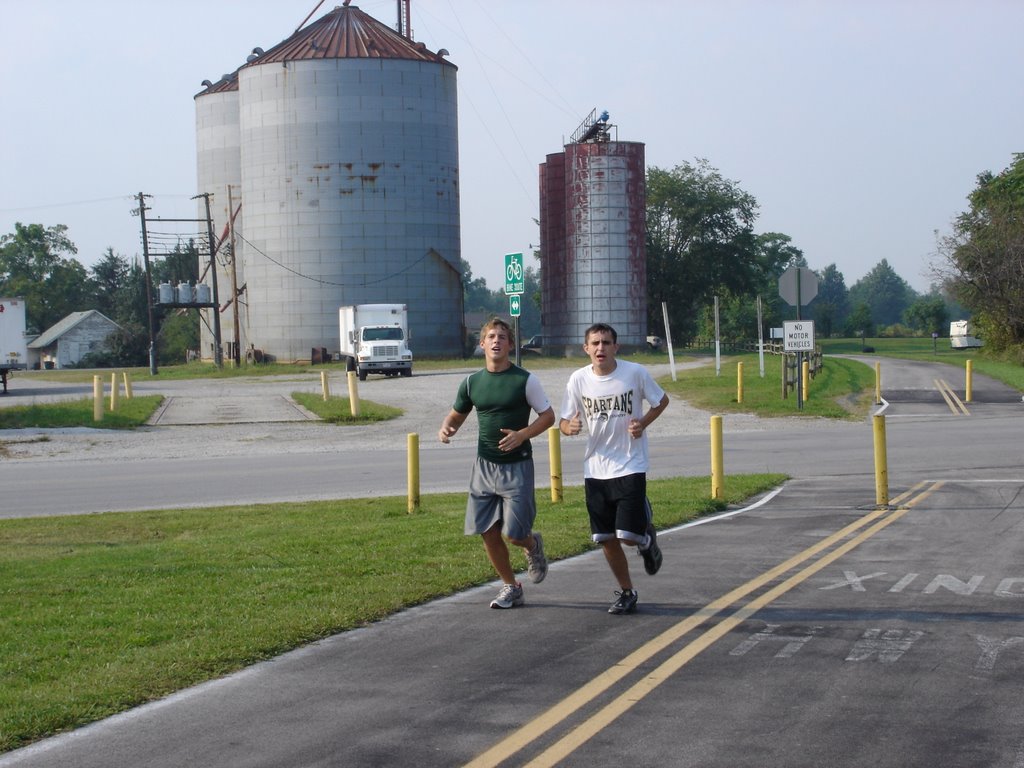 This year, there was no 7-mile option. There was a 14-mile option, which no one took (one was ready but hurt a calf earlier this week). All went 10 miles, and I think 5 out of the 9 boys had never run that far in their lives (although 8 miles is a weekly occurrence). For a developing program, 10 miles is decent. I'd like more, but you've got to start somewhere.
The big thing I'm trying to teach these kids is one of Arthur Lydiard's mantras: You can run too fast to develop aerobic efficiency, but you can never run too slow. This is the opposite of what we Americans have been led to think, which is "long, slow running leads to long, slow runners". In fact, I have a hard time believing the old Kiwi myself sometimes, but so far their times are generally a whole minute faster than last year at the same meets.
Not that it's all just jogging around. We do plenty of that, but they also do plyometrics, strides, repeats and races. Everything has its place and time. Tinman is of the opinion that aerobic training is the cement that holds everything else together, and one major mistake runners make is dropping their milage too early in the season. It's as if we're afraid of aerobic running, like we don't trust it. Well, I'm going to put my trust in it, and we'll see how it goes for the rest of the season.
Thursday, September 07, 2006
Will wonders never cease
If you've read any sports news lately, you've seen that Marion Jones' B-sample came back negative. Heck, it even made NPR.
I'm not going to be able to add much to the discussion. I will say she got hit by a test with a history of B-negatives. The EPO test has been called "notoriously unreliable", and anti-doping guru Dr. Don Catlin has reported estimated 10 false negatives for every true positive with this test.
Jones will not, and should not, be banned for using EPO. However, I don't think anyone reasonably believes a blood booster is the reason she won a sprint-record twelve world-#1 rankings.
I'm not going to be able to add much to the discussion. I will say she got hit by a test with a history of B-negatives. The EPO test has been called "notoriously unreliable", and anti-doping guru Dr. Don Catlin has reported estimated 10 false negatives for every true positive with this test.
Jones will not, and should not, be banned for using EPO. However, I don't think anyone reasonably believes a blood booster is the reason she won a sprint-record twelve world-#1 rankings.
Monday, September 04, 2006
Fantasy League update
Here are the current standings:
MEN
WOMEN
So I've got a 22-point lead on my wife's team.
A quick recap on where the points come from...
Team totals are the sum of the eight best athletes on each team
Athlete totals are from the following:
1) IAAF World Rankings points divided by ten
2) Best point total from any single event in the World Athletics Tour
3) Bonus for any Golden League jackpot winnings (1 point per $10,000)
4) Best single result from the World Athletics Final
5) Best single result from the World Indoor Championships, World Cross Country Championships, and World Cup
(#4 and #5 score on a 30-24-21-18-15-12-9-6 basis)
So the most important competitions are yet to come. First up is the World Athletics Final next weekend. All of the top eight athletes on both teams will be competing.
MEN
| Asafa POWELL | JAM | 100m | 275.7 |
| Jeremy WARINER | USA | 200m, 400m | 266.5 |
| Kenenisa BEKELE | ETH | 5k, 10k | 250.2 |
| Bershawn JACKSON | USA | 400mH | 233.2 |
| Virgilijus ALEKNA | LTU | DT | 228.8 |
| Daniel Kipchirchir KOMEN | KEN | 1500m | 222.5 |
| Dwight PHILLIPS | USA | LJ | 204.3 |
| Brad WALKER | USA | PV | 200.8 |
| Saif Saaeed SHAHEEN | QAT | 3000mSC | 200.1 |
| Justin GATLIN | USA | 100m,200m | 186.7 |
| Dominique ARNOLD | USA | 110mH | 183.8 |
| Ladji DOUCOURÉ | FRA | 110mH | 146.1 |
| Team Total | 1882.0 |
WOMEN
| Sanya RICHARDS | USA | 400m | 264.1 |
| Tirunesh DIBABA | ETH | 5k, 10k | 247.9 |
| Michelle PERRY | USA | 100mH | 238.6 |
| Yelena ISINBAYEVA | RUS | PV | 233.9 |
| Meseret DEFAR | ETH | 5000m | 224.0 |
| Lashinda DEMUS | USA | 400mH | 222.0 |
| Blanka VLASIC | CRO | HJ | 220.0 |
| Susanna KALLUR | SWE | 100mH | 209.5 |
| Berhane ADERE | ETH | 5k, 10k | 172.2 |
| Ejegayehu DIBABA | ETH | 5k, 10k | 158.9 |
| Veronica CAMPBELL | JAM | 100m,200m | 142.8 |
| Christine ARRON | FRA | 100m,200m | 132.4 |
| Team Total | 1860.0 |
So I've got a 22-point lead on my wife's team.
A quick recap on where the points come from...
Team totals are the sum of the eight best athletes on each team
Athlete totals are from the following:
1) IAAF World Rankings points divided by ten
2) Best point total from any single event in the World Athletics Tour
3) Bonus for any Golden League jackpot winnings (1 point per $10,000)
4) Best single result from the World Athletics Final
5) Best single result from the World Indoor Championships, World Cross Country Championships, and World Cup
(#4 and #5 score on a 30-24-21-18-15-12-9-6 basis)
So the most important competitions are yet to come. First up is the World Athletics Final next weekend. All of the top eight athletes on both teams will be competing.
Tags:
Sunday, September 03, 2006
Back on track
I haven't posted for quite a while. School just started this week, and a family wedding I was in took place yesterday. Those two events plus coaching eliminated basically all of my free time; I did find a few minutes to see a college dual meet on Friday afternoon, but that's been basically it.
I had no interest in coaching again when the boys' coach at our school came to me last June and told me he was retiring. He just wouldn't leave me alone until I said I'd think about it, and the more I thought about it the more I thought I'd enjoy it. So I took it. I have a wonderful group of boys, and while they're not going to be a dominant team this year they are all making big improvements.
I'm a big proponent of the Arthur Lydiard system of training (and its stepchild, the Tom Osler system). The whole idea is long-term development...and I didn't have a lot of time, so rather than following a traditional system I had to improvise and do what I could. Our training has stressed aerobic development first and foremost, with leg strength/power/speed next most important. Lydiard rightly saw anaerobic endurance as a capstone, not a building block, so we only started doing repeats this week (six weeks away from our first important meet).
One reason I took the job was that I'd had a number of ideas floating around in my head and I wanted to try them out. One is for races. I haven't taken a single mile split in either of our first two races. (I figure mile splits in XC are essentially meaningless, considering variation in terrain and/or footing along with the uncertainty that markers are placed correctly.) Instead, I've kept track of what place each athlete was in at the mile and 2-mile marks as well as the finish, with the idea that good pacing leads to an overall upward movement throughout the race. Moreover, this approach means the athletes have to pay attention to internal cues in order to find that correct pacing, rather than listening for a time. I takes longer to learn, but in the long run I think the athletes will do better.
Another experiment came last week in our first interval session. I laid out a sort of a figure-eight course in a local park, with one loop for repeats and the other for a jogging recovery in between. The kids asked me "How far is it?" and I said I didn't know. They asked me "How many are we going to run?" and I said I didn't know. They asked me "How fast are we supposed to run?" and I said I didn't know. I told them the point of the workout was to run fast until they got tired enough, and nothing else mattered. With their input, I'd decide when each kid had become sufficiently tired and cut them off at that point. The result? I'm pretty sure they got considerably more out of themselves than if I'd done the typical thing of telling them how far, how many and how fast.
By the way, yesterday all athletes (save one) improved by over a minute as compared to the same meet last year. We'll see if that continues...
I had no interest in coaching again when the boys' coach at our school came to me last June and told me he was retiring. He just wouldn't leave me alone until I said I'd think about it, and the more I thought about it the more I thought I'd enjoy it. So I took it. I have a wonderful group of boys, and while they're not going to be a dominant team this year they are all making big improvements.
I'm a big proponent of the Arthur Lydiard system of training (and its stepchild, the Tom Osler system). The whole idea is long-term development...and I didn't have a lot of time, so rather than following a traditional system I had to improvise and do what I could. Our training has stressed aerobic development first and foremost, with leg strength/power/speed next most important. Lydiard rightly saw anaerobic endurance as a capstone, not a building block, so we only started doing repeats this week (six weeks away from our first important meet).
One reason I took the job was that I'd had a number of ideas floating around in my head and I wanted to try them out. One is for races. I haven't taken a single mile split in either of our first two races. (I figure mile splits in XC are essentially meaningless, considering variation in terrain and/or footing along with the uncertainty that markers are placed correctly.) Instead, I've kept track of what place each athlete was in at the mile and 2-mile marks as well as the finish, with the idea that good pacing leads to an overall upward movement throughout the race. Moreover, this approach means the athletes have to pay attention to internal cues in order to find that correct pacing, rather than listening for a time. I takes longer to learn, but in the long run I think the athletes will do better.
Another experiment came last week in our first interval session. I laid out a sort of a figure-eight course in a local park, with one loop for repeats and the other for a jogging recovery in between. The kids asked me "How far is it?" and I said I didn't know. They asked me "How many are we going to run?" and I said I didn't know. They asked me "How fast are we supposed to run?" and I said I didn't know. I told them the point of the workout was to run fast until they got tired enough, and nothing else mattered. With their input, I'd decide when each kid had become sufficiently tired and cut them off at that point. The result? I'm pretty sure they got considerably more out of themselves than if I'd done the typical thing of telling them how far, how many and how fast.
By the way, yesterday all athletes (save one) improved by over a minute as compared to the same meet last year. We'll see if that continues...
Subscribe to:
Posts (Atom)

 Posts
Posts


