The oldest track & field blog on the internet

Showing posts with label ESPN. Show all posts

Thursday, July 08, 2010

ESPN Responds

Earlier today, ESPN ombudsman Don Ohlmeyer wrote about many things, vuvuzelas included, but item #3 was a well-reasoned response to last Friday's cutaway during the USATF Championships 5k to show the end of a baseball no-hitter.
Nothing is more galling for a sports fan than being engrossed in a live event only to have it hijacked in midflight. At 9:49 p.m. ET on June 25, ESPN did just that to 837,000 ardent fans watching the USA Outdoor Track & Field Championships. With less than two laps to go in the men's 5,000-meter run, the network cut away to live coverage of the final three outs of a no-hitter pitched by Arizona's Edwin Jackson. The track viewers were suddenly transported to the ninth inning of the Diamondbacks' eventual 1-0 victory over Tampa Bay. The excitement was palpable as Jackson induced a strikeout and a fly out, gave up a walk, then got Jason Bartlett to ground out. Pandemonium ensued as Jackson etched his name into baseball history.

ESPN's coup provided a memorable service … to baseball fans. Unfortunately, it was an insulting disservice to the track audience, and the mailbag quickly reflected that with a barrage of comments. Track viewers were livid. Some called it "unprofessional" and "arrogant" and "a slap in the face." Others: "If I wanted to watch baseball I would have watched baseball" … "It shows no respect for track fans" … "I guess the U.S. championships was just filler programming until something better came along."

The offense was compounded when, after a seven-minute baseball cut-in, the network went directly to "Baseball Tonight," forcing the track audience to wait another 39 minutes to see a 60-second recap of the 5,000 and results of the 100-meter dash. You could not choreograph a better way to alienate an audience. The ESPN decision has repercussions, creating ill will and straining loyalty.
To his credit, he eventually gets to the point: ESPN is contractually obligated to show the final outs of any no-hitter, and to do so on the flagship channel rather than ESPN2 or ESPN News.
Such decisions are made in the blink of an eye. Often, they're determined by the strength and passion of the advocates in the control room. Programming's responsibility is the orderly execution and flow of the various elements running on the network -- in contrast, a producer's perspective totally revolves around specific telecasts, whether event or studio productions (such as "Monday Night Football" or "SportsCenter"). These two groups interact smoothly hundreds of times each week, but there can be tension, and the discussions over decisions such as this can get loud and sometimes very heated.

The producers of the track event wanted to continue serving their viewers. The "Baseball Tonight" producers anticipated the excitement and audience the no-hitter could generate if carried over directly into their broadcast. Programming played Solomon, and in this case got steamrolled by the BBTN team.
In other words, the cool kids bullied the track nerds into changing the channel. But here's the kicker:
Was the move worth it? From a ratings perspective, ESPN picked up 160,000 viewers during the cut-in (many of which likely came from the College World Series being shown at the same time on ESPN2). That would only be natural -- they're baseball fans. But for BBTN, the fastest-paced, cleanest show on television, it was a Pyrrhic victory. Many viewers didn't stay. Just 20 minutes into the program, its audience had dropped from 1 million to 750,000.
At the top, he said the track meet was pulling 837,000 viewers. The no-hitter only got it up to 1 million which quickly dropped to 750,000 during Baseball Tonight, which programmers believe to be one of their top shows. And then ESPN got inundated with so much hate mail that their ombudsman had to respond.

Track people basically hit the programming bullies in the nose. We showed management that there are a lot of us, we are very engaged, and we follow through. You know, the kind of thing that advertisers are in love with. Rest assured, this incident has been noticed in Bristol.

Friday, April 09, 2010

Usain Bolt is...everywhere

Even before Usain Bolt announced he'll run the Penn Relays he was everywhere. He's profiled in this month's Esquire magazine. ESPN's Page 2 has a nice piece, too:

It made me think about the past dozen years or so, as Columbia Records started releasing a string of Miles Davis box sets, such as "Bitches Brew Sessions," "On The Corner Sessions," "Jack Johnson Sessions" -- all material recorded in 1970 or earlier. The thing is, the music was so advanced that folks still haven't caught up...

Bolt is like Miles. He's a sprinter from the future who traveled back to our time to run so fast it turns our brain into mush trying to comprehend an actual human blur.

...Imagine if "Avatar" was released the same week as "Star Wars" back in 1977. That's what we're talking here. Asafa Powell and all the other world-class sprinters are "Star Wars." Bolt is "Avatar."

Wednesday, February 24, 2010

NFL Combine

As discussed ad infinitum elsewhere, 40-yard dash times are notoriously imprecise. But ESPN has given us a "cheat sheet" for the upcoming NFL combine.

Note that Darrell Green supposedly ran 4.43 on his recent 50th birthday. That would have made him 5th best at last year's combine.

Monday, December 14, 2009

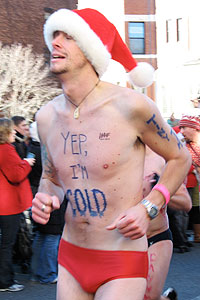
Santa Speedo Run

ESPN's Page 2 covers The Hub's second-most important annual road race.

Key quotes:

"We were sitting around one Thursday night at the bar, and somebody said, 'We should do something fun and stupid like we used to when we were younger.'"

"There are rare opportunities where you get to be a complete idiot, yet do good and raise money."

Wednesday, November 04, 2009

Guess I'm A Sports Dufus

ESPN's Page 2 has a column listing the 20 things that make you look like a sports dufus.
Sooner or later, every last one of us ends up looking like a sports doofus -- casting sound social judgment overboard, setting sail with the tempestuous winds of passionate fandom, dropping anchor in the murky waters of athletic-related behavior that comes across as utterly ridiculous.
And I'm guilty of one of them.
11. Running in a rainstorm

Dubious behavior: Lacing up your $100-plus ergonomic distance shoes, throwing on a sweat-wicking top and going for a long run in the pouring rain.

Doofus factor: Moderate. On one hand, it's hard to fault the dedication of someone willing to exercise in inclement weather, particularly when physical fitness helps ease the burden on our overtaxed health care system; on the other hand, there was only one Steve Prefontaine, and you're not exactly reducing health costs when you're subsequently hospitalized with severe bronchitis.

Suggested solution: One word: treadmill. Two more: indoor track.

Mitigating circumstances: Your local television weatherman meteorologist got it wrong. Which basically excuses everyone.

Related behaviors: Golfing in a rainstorm, the way Tiger Woods did in that commercial.
And I know why I do this. Because, as explained in #10 Wearing baseball pants to play slo-pitch softball, I am "someone whose uncontrollable, indiscriminate competitive fire would be better suited on a driving and/or firing range."

Monday, October 26, 2009

Green Man?

Who the heck is the Green Man?
And why is he running the Chicago Marathon?

ESPN explains.

Tuesday, September 01, 2009

Celebrations

Bill Simmons, aka ESPN's Sports Guy, regularly publishes a steaming pile of writing he calls a "mailbag". It's entertaining, but rarely has much to do with sports. But here he stumbles across the truth.
[E]ach sport has its own unique celebration to some degree. Here they are:

Baseball: Walk-off hit followed by a circle with dudes jumping up and down in unison.

Football: Guy dances by himself as teammates watch him.

Basketball: Guy struts back up the court after a big shot, makes the Tony Montana "sticking out the lower jaw trying to look like a badass" face, preens for the crowd and eventually gets chest-bumped angrily by other people his size.

Hockey/soccer: Scorer gleefully skates/runs away from the goal and gets mobbed by teammates.

Golf: Awkward fist pump after a putt, followed by an extremely awkward high-five with a caddy.

Tennis: Guy sinks to his knees like he's absolutely incredulous (even if he's not).

Here's my question: Are we happy with these matches of sport and celebration? For instance, I'd love to see baseball players adopt the tennis celebration: hit a homer and just sink to your knees in complete shock for five seconds as everyone angrily stares at you. Wouldn't it be more fun if the winning tennis player sprinted 40 yards like a soccer player and acted like a crazy person? What if a golfer and caddy did a two-man jump-up-and-down celebration like baseball players after a walk-off?

Also, why are we so content with the celebrations we have? I love Ovechkin's self-check into the boards. It's fantastic. Why couldn't someone like Chris Paul make a big shot, wait for the timeout, run over to the scorer's table, then stage-dive into his sea of teammates like they're a giant mosh pit? Why couldn't a golfer hand his putter back to his caddy and his caddy could pretend to be electrocuted by it? Maybe the golfer could pretend that he's also being electrocuted, and they could stand there vibrating for a couple of seconds? We need more clever celebrations heading into this next decade.

Track's celebration? Drape self in flag, jog victory lap. Bo-ring.

Usain Bolt broke out of this mold and it's a big part of his tremendous popularity. His celebrations are pure joy. Berlino helped a few other athletes do something different and made news in such non-track places as Kent Jones' Just Enough feature on the Rachel Maddow Show.

Recently, Blanca Vlasic has taken to doing weird European disco moves after making a big height. At the Zurich Weltklasse meet, Yelena Isinbayeva went berserk when she set her world record, but that doesn't really fall into the category of clever. Remember when Mo Greene had someone use a fire extinguisher on his shoes? Now that was entertaining.

Yes, we need creative celebrations.

Friday, August 28, 2009

Six at Eleven

RW Daily has all the headlines, including previews of the big Zurich Weltkasse meet.

Speaking of Zurich, nearly 5000 fans came to the rail station to see Usain Bolt arrive yesterday.

Scott Bush suggests USATF fan fests. I'd go.

ESPN's Outside the Lines has a report on Al Joyner's daughter and the memory of FloJo.

Jessica Ennis is making noise about going after Denise Lewis' UK heptathlon record.

Threadspotting: Women's Athlete of the Year?

Saturday, July 11, 2009

Let's Run, SportsCenter

The day after the Lausanne Super GP meet, Usain Bolt's 19.59 run in the rain made SportsCenter's top ten plays. The lead in was a snyde, but funny, remark: "What's the only thing more boring than track? Field."

Needless to say, this ticked off quite a few people. The Brojos did a little digging and found out the background and interests of the anchor who said it, John Anderson. You'd be surprised. Very surprised.

Friday, May 29, 2009

More on What Are Sports For?

Two days ago I answered Jeff MacGregor's question What are sports for? In the meantime, I discussed the topic with my brother. No stranger he to deep thinking.

He identified three basic things: tribalism, drama, and transcendence.

Tribalism is very connected to team sports, and explains why the USA, among the most individualistic societies on earth, prefers them over individual sports. It's why the Olympics are the most meaningful of track competitions--the national team thing means something to the more casual observer--and I think track & field ignores this at its own peril.

Tribalism is also the single biggest reason sports fans will turn a blind eye towards doping. It's OK if our guys are doing it, they're just keeping up with the competition. And then there's the issue of simple blind loyalty, which I noted a couple of years ago:
...a friend who is an Indians fan was very defensive about Albert Belle when he played for Cleveland, but once he left the team she said "Thank God I don't have to be an apologist for that jackass anymore". (One can glean a deep understanding of political attitudes amongst ordinary Americans by observing this type of behavior; in this perspective, Fox News finally makes sense.) Bonds is so distasteful a character that quite a few Giants fans still won't stick up for him.
USATF (or TAC, as it was known back then) did cover up doping and aid the USOC in doing so back in the 1980s because otherwise our athletes were at a competitive disadvantage against the Communists.

Drama is that stuff that Jim McKay talked about at the beginning of Wild, Wild World of Sports: "Spanning the globe to bring you the constant variety of sport… the thrill of victory… and the agony of defeat… the human drama of athletic competition". Doping can cheapen this, but only somewhat. If you only look at sports as theater, then the main difference between the Boston Marathon and WWE is whether or not the outcome is unknown. And you have to admit, pro wrestling is capable of some mighty fine working-class kabuki theater. Yet few of us would call it real sports.

It's in transcendence that doping is the most damaging. All of us can recall amazing sports happenings, be they by the greatest professionals or commonplace high schoolers, that would be cheapened if they were something less than ordinary human beings doing extraordinary things. They are heroes because their superpowers were not stolen, but granted by their maker and/or earned by blood, sweat and tears.

Wednesday, May 27, 2009

What Are Sports For?

When I came home from school today, I turned on the tube and Chariots of Fire was on one of the HD channels. So I sat and watched it. I haven't seen it for a while, and never in HD.

A lot of people think this, the 1981 Oscar winner for Best Picture, is an overrated film. I've always liked it. I'm not sure why; my ancestry is heavily English and Scottish, so maybe that's part of it. But also, it's a very idea-heavy film, and I'm into thinking about ideas.

This is why I'm so affected by a recent ESPN Page 2 column. Jeff MacGregor, who writes This Sporting Life, asked What are sports for?

Baseball is finally having its crisis of confidence that track & field had twenty years ago. As such, baseball writers are asking philosophical questions about whether PEDs should be legal, and why or why not. As an extension, MacGregor asks what purpose modern professional sports serve: to teach moral lessons, or to provide an entertaining diversion?

Of course, the truth is both, and neither. One thing that it does is allow us to think the best of ourselves, or at least those we believe ourselves to be associated with. Watching the movie, I found myself singing along to Gilbert & Sullivan's For He Is An Englishman, feeling proud to call myself of English heritage. My college roommate once posed the question of why we feel this pride, when every nation on the earth has done horrible things to other people as well as its own. My reply was that we think of the best of our history, and hope to emulate it. For mine, it would be prevailing in WWII, after a massive struggle just to survive.

In any case, sports allow us to feel a pride at the success an athlete or team with whom we feel a connection. Examples are New Englanders and their Red Sox, or Clevelanders to their Browns, and so on in hundreds of ways. Besides a connection to our city, or school, or country, we have a connection to the fans of that same team. But this still doesn't answer the question of whether PEDs should be banned or tolerated.

Throughout Chariots, this question of what are sports for? is brought up again and again. Harold Abrahams, the outsider Jew at Cambridge, the ultimate insider's school, has to answer it multiple times. More or less, he cannot be a full man without striving to be the best he could be. As sports fans, few things incense us more than teams or athletes who give less than their best effort.

And we don't mean any mamby-pamby feel-good "oh, just so you tried your hardest" stuff. It is the driving to the very edge of your capabilities that is the essence of competing as an athlete, or watching them compete. We want to find our best (or see theirs). In other words, the true meaning of sports is not the triumph but the struggle. But that still doesn't answer the question of whether PEDs should be banned or tolerated.

The IOC banned doping in 1972 mostly because they feared literally killing their golden geese. In 1967, Tom Simpson died during the Tour de France when he took amphetamines before a mountain stage. Without controls many athletes would likely dope themselves to death. So there are those who say we should allow doping if done safely and under the supervision of a doctor--to which I reply, in what way is that easier to police than our current complete ban on doping? Given the opportunity, just enough people will take short-term gain over long-term viability to screw the whole system, which is more or less why financial markets need regulation.

But none of this gets to the real reason why the majority who don't like doping find it so distasteful. It's not intellectual, it's visceral. We must look to Eric Liddell, the Scottish long sprinter in Chariots. He was a dedicated missionary, whose wife found his running a distraction to their religious calling. In the film he told her he must continue to compete in sports because "I believe God made me for a purpose. But He also made me fast. And when I run, I feel His pleasure." PEDs are an attempt, as coach Sam Mussabini said, to "put in what God left out".

Yeah, yeah, excessive moralizing. I don't think so. I think it's a religious person's way of explaining an experience sports fans have with regularity and probably seek more than any other thing. It's the slack-jawed amazement we have at seeing the fantastic things athletes do. Be it Mine That Bird winning at 50-1, or a buzzer-beater 3-point shot, or a Statue of Liberty play to win in overtime, they make us ten years old again. The top two for me were seeing the Carl Lewis / Mike Powell long jump duel at the 1991 Worlds, and being 20 feet away from Tyson Gay's stunning runs at the 2007 USATF Championships.

PEDs alter hormonal profiles to ones that are unnatural, so the athletes are no longer human beings as we know them. They rob us of that awe, that child-like wonder.

Friday, May 15, 2009

David versus Goliath

Recently, Malcolm Galdwell (of The Tipping Point, Blink, and Outliers fame) wrote a piece for the New Yorker on David vs. Goliath situations and how unconventional strategies are crucial to increasing an underdog’s chances of success.

The part that has gotten the most ink...er, electrons, in the sports blogosphere is an insistence that the full-court press can even the odds in an unbalanced basketball matchup. In a follow-up back and forth with ESPN’s Bill Simmons, he states
After my piece ran in The New Yorker, one of the most common responses I got was people saying, well, the reason more people don't use the press is that it can be beaten with a well-coached team and a good point guard. That is (A) absolutely true and (B) beside the point. The press doesn't guarantee victory. It simply represents the underdog's best chance of victory. It raises their odds from zero to maybe 50-50. I think, in fact, that you can argue that a pressing team is always going to have real difficulty against a truly elite team. But so what? Everyone, regardless of how they play, is going to have real difficulty against truly elite teams. It's not a strategy for being the best. It's a strategy for being better. I never thought Louisville -- or, for that matter, Missouri -- had a realistic shot at winning it all in the NCAAs this year. But if neither of those teams pressed, they wouldn't have been there in the first place.
So the gist of what he’s saying is that when you know you’re going to lose under normal strategies, there’s no harm in trying something wildly different. The worst that can happen is what’s nearly certain to happen anyway. I think he’s sticking to the press because of a singular lack of other examples in basketball.

Back when I was in high school, we had one. The second-best team in our league, Macomber, was without their center for an extended period of time due to mono, and were simply undermanned when they went up against the top team, St. Francis—who happened to be ranked #1 in Ohio going into the game. Macomber had a potent weapon, a freshman you may have heard of named Jimmy Jackson (a long-time NBA vet and current Big Ten Network analyst) but he wasn’t going to be enough by himself.

So they tried something different. Macomber held the ball. The final score was 13 to 11 in favor of Macomber, who then advanced to and won the league championship game. Oh, people were pissed. They said it was unsportsmanlike. But it was completely within the rules and used the one favorable imbalance—point guard—to neutralize the other eleven unfavorable ones.

So how does this apply to track & field? In general, strategy doesn’t play much of a role. The better athlete on the day of competition nearly always wins, and strategy mostly plays a role in that you don’t want to screw it up. (See Richards, Sanya).

There are examples of innovation in track & field, Dick Fosbury being the most famous example. In the shot put, there was the O’Brien shift and the Oldfield spin, and in the pole vault and javelin there were various innovations in materials and technology. But all of these represent serendipitous discovery of the best way to do things which were soon copied by everyone, not truly unconventional strategies that neutralize wide variances in ability.

On a more ordinary level, unconventional strategies can play a role. The standard setup for a high school team is to have the fastest kids running the sprints, the next fastest in the hurdles and 400, the next group in the middle distance, and the slowest in the long distances. And the only way you can win your league this way is to have superior levels of talent up and down the line. Furthermore, you’ll never discover the next Renaldo Nehemiah or Bernard Lagat that way.

Of course, a good coach will understand where an athlete’s true talents lie and direct them to whatever event that is. And if your team happens to be completely devoid of any real speed, you may end up completely abandoning the sprint relays in favor of the 800 and 300 hurdles and so forth—events that, around here at least, tend not to be terribly deep because they’re unglamorous and take some talent but also take a lot of hard work and guts. And that’s one of the things Gladwell touches on in his article: if your talent is inferior, not only must your strategy take this into account, but you must also work harder than your opponents. Much harder.

There is one famous example of a successful unconventional strategy in the annals of Olympic track & field, one that uses all of the elements Gladwell talks about.

In 1966 and 1967, Jim Ryun dominated the 1500 meters and mile in a way that has never been surpassed, before or since. He was the ultimate Goliath. There were issues he took into the 1968 Olympics, leg injuries and mono, but he had recovered from them and was still Jim F***ing Ryun.

Despite the Olympics being held at more than 7300 feet of altitude, and Kip Keino having lived his whole life in similarly thin air, he still thought he needed an unconventional strategy to win. Teammate Ben Jipcho took the pace out hard for the first lap while Keino and Ryun hung back. On the second lap, Keino surged to the front while Ryun continued to hang back. On the third lap Keino went for broke, and put so much distance on Ryun that the race was essentially over.

While I think the race was Ryun’s to win, Keino did make him face a moment of truth about 800 or 900 meters into it where he hesitated and lost. Keino’s strategy was unconventional, and made the most of his strength (endurance at altitude) and the least of his weakness (lack of finishing speed). He was willing to suffer the agonies of the damned and take an all-or-nothing risk while Ryun did not, who as the heavy favorite was expected to see anything but gold as failure.

But also, Keino did something that the establishment questioned in terms of its sportsmanship. Gladwell:
This is the second half of the insurgent’s creed. Insurgents work harder than Goliath. But their other advantage is that they will do what is “socially horrifying”—they will challenge the conventions about how battles are supposed to be fought. All the things that distinguish the ideal basketball player are acts of skill and coördination. When the game becomes about effort over ability, it becomes unrecognizable—a shocking mixture of broken plays and flailing limbs and usually competent players panicking and throwing the ball out of bounds. You have to be outside the establishment—a foreigner new to the game or a skinny kid from New York at the end of the bench—to have the audacity to play it that way.
The Kenyan’s teamwork was considered by some to be outside the bounds of fair play. Jipcho himself thought so within a few years. But such collusion is totally and completely within the rules, and the Keino still had to run faster than Ryun in order to win the race. But he managed to do it on his terms instead of Ryun’s terms.

And that’s the whole idea that Gladwell is getting at: if you’re supposed to lose, at least put yourself in charge of the situation.

Sunday, May 10, 2009

Bill Simmons Understands Doping

Bill Simmons, ESPN's Sports Guy, has a column describing how he might be looking back at baseball's "steroid era" five years from now. Substitute "track stars" for "baseball players", "1980s" for "steroid era", and "see the USA & western Europe beat the East Germans & Soviets" for "see the Red Sox win a World Series", and you've got the experiences of most every track fan born before Watergate.

He gets it. Yeah, in retrospect you'd have to be deluding yourself to not know they were pretty much all juiced to the gills. But the desire to see your own team win can blind you to what is clearly outside of our common moral boundaries. And it's not just limited to sports; how else can you explain large numbers of Americans defending the use of torture, if not for the desire to be with a winning team?

Monday, April 20, 2009

Boston Marathon reactions

Results
AP article / IAAF recap

My thoughts on this morning's Boston Marathon…

Why was it not on TV? It was on Universal Sports, but almost no one gets that. It was carried on ESPN's foreign affiliates, such as Canada's TSN.

I'm not sure either Ryan Hall or Kara Goucher could have won, but I think both followed strategies that made it more difficult.

Goucher's strategy was jog 20 miles and race 10k, which allowed far too many athletes to hand around. The longer I saw Dire Tune in the picture, the more I thought about a) her close win a year ago and b) her track world record. Based on Tune's post-race stretcher cart-off, if the pace had been pressed earlier I doubt she would have beaten Goucher.

Hall's press from the gun / wait and see strategy didn't get rid of anybody except runners that weren't going to make a difference anyway, and it may have used up just enough energy that he couldn't respond when Merga made the real break. Had he been able to keep it close, he might have been able to reel in Merga near the end.

I think both of these strategies can be considered playing from a position of weakness; Hall's in fear of a too-slow race and Goucher's in fear of a too-fast one. Like poker, you'll only win in marathoning from a position of weakness if the cards break just right.

Did you see who was #1 in my men's road race rankings last week? Deriba Merga.

Did you see who was #3 in my women's road race rankings? Dire Tune. First (Aselefech Mergia) wasn't in the race and second (Vivian Cheruyiot) isn't a marathoner. Goucher was fourth and Kosgei way back in 37th.

I watched it online (I taught during the early miles and kept my students busy during the real nitty-gritty). I'm so glad I didn't get to hear Larry Rawson's awful announcing. From the Let's Run thread: "The holy grail: Larry Rawson has managed to combine 'the shoes weigh the same as two slices of bread' AND 'leg turnover' in one sentence."

Are either Hall or Goucher interested in winning Boston specifically or just a major marathon in general? Because everyone says Boston has a learning curve. It's no surprise that the same Kenyans keep coming back to there every year. London, Berlin and Chicago don't have a learning curve: pacemakers + flat course = brainless running 'til you're the last one standing.

If Boston and New York get far and away the lion's share of domestic marathon media attention, and shoe companies invest in American marathoners in order to sell sporting goods in the USA, why don't their contracts provide strong incentives for Americans to run New York and/or Boston?

Late Edits: I don't want it to sound like I think Hall and Goucher threw away wins; most likely, Merga and Kosgei would have won in any case. But I don't think they gave themselves the best chance to win.

The race got decent coverage on ESPN. It was in the "Mailbag" segment on PTI (Tony Kornheiser joked that Tune should have dove at Kosgei's feet) and prominent on SportsCenter (that fat tub of goo John Kruk said he was late to the studio because he ran the race).

Friday, April 17, 2009

Bill Simmons on Boston

ESPN's Sports Guy wrote an "Idiot's Guide to the Boston Marathon" a few years ago. Check it out.

As usual for him, it's hilarious and spot-on. My favorite portion of the column is about his "tiers" of runners -- first is the foreign pros, second is the American pros (Here come the white guys!), third is the elite amateur men and pro women, fourth is average guys in superb shape (the guys in college that A) hit on your girlfriend when you were away for the weekend, B) rowed crew, and C) drove Miatas), fifth is the break-3:30 group (Really, really hot, scantily-clad chicks in superb shape. God bless the invention of the jogging bra...it's probably the only time you can openly goggle women without their "Somebody's checking me out" radar kicking in.).

But the last is his favorite group to watch.
Now we've entered the "freak" portion of the race: People trying to finish in four hours or less, running alongside college kids carrying fraternity flags, transvestites, people dressed in Viking garb and wackos wearing Larry Bird jerseys or multi-colored afros. There are some strange people out there.
There's more, it's great.

Sunday, April 12, 2009

Best Undefeated Seasons?

ESPN's Page 2 has ranked its 40 best undefeated seasons in sports history, putting the Pele-led 1970 Brazilian World Cup champs at #1. These were teams only, no individuals.

I'm thinking about the greatest undefeated seasons in track history and seeing what I can put together. Off the top of my head, Carl Lewis in 1984 and Paavo Nurmi in 1923-24 belong near the top of the heap.

I can tell you who doesn't make the cut: Jesse Owens in 1936 (a post-Olympic loss to Ralph Metcalfe in the 100 nixes that), Emil Zatopek in 1952 (a pair of early-season thirds in 5k races takes him out), Michael Johnson in 1996 (lost his last pre-Olympic 200 to Frankie Fredericks), and Usain Bolt in 2008 (a 100m loss in Stockholm to Asafa Powell). For athletes who compete often and in multiple events, it's not easy.

Saturday, March 07, 2009

Bill Simmons on Bruce Jenner

ESPN's Sports Guy does a mailbag shtick every so often. In the most recent:

Q: Do you think if someone told Bruce Jenner in 1976 that he'd spend his golden years trying to steer the misguided children of a lawyer who successfully defended O.J. Simpson from charges of killing his own wife, or that his son would introduce the world to the concept of a "bromance," he would have thrown his discus or javelin off to the side and taken the silver medal in the decathlon?
-- Ben S., Lexington, Mass.

SG: And you left out the fact that he now looks like a female librarian. I just don't think he would have believed you in 1976 -- he thought he was going to be a movie star and the biggest endorsement celeb in the world. It couldn't have turned out worse. It's impossible.

Tuesday, February 10, 2009

Smith and Carlos Together Again

On ESPN's First Take yesterday, they actually managed to get Tommie Smith and John Carlos in the same room. Video is here.

For a rundown on where the bad blood came from, check out this LA Times article from last summer.

Sunday, March 02, 2008

ESPN notices track

...and I've seen Obama yard signs in my 99.5% non-black suburb. I expect Beelzebub himself to deliver a snowball from the gates of Hell any day now.

Alan Grant profiles Breaux Greer in the current issue of ESPN Magazine. The teaser should catch people's eyes:
ROGUE SPEAR
As Beijing beckons, the best javelin-thrower in U.S. history asks for—make that demands—your attention. But if he doesn't get it, Breaux Greer always has plan B: "I think I'll do porn."